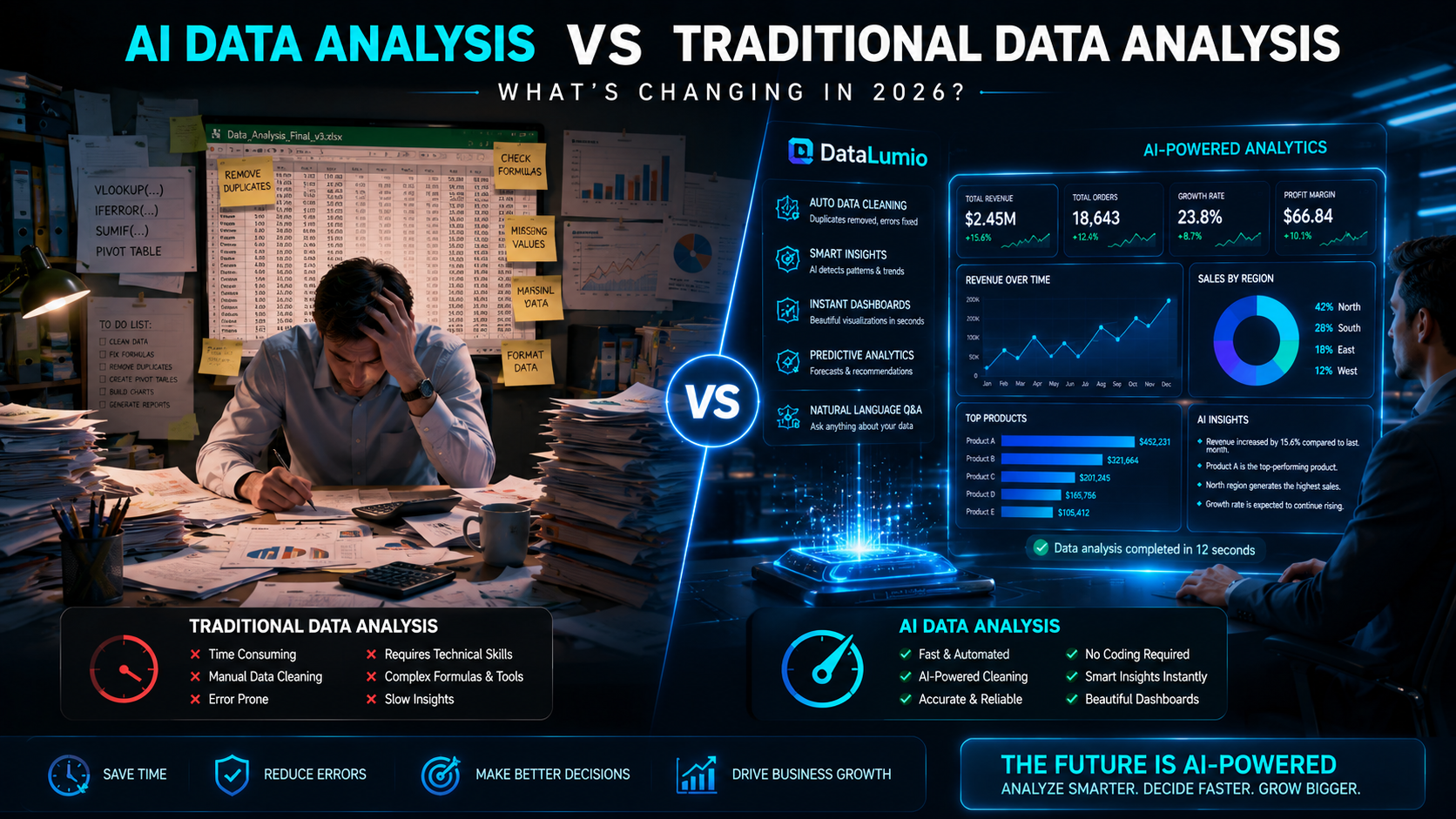
Businesses today generate more data than ever before. From spreadsheets and surveys to financial reports and customer analytics, organizations rely heavily on data to make decisions. But the way data is analyzed is rapidly evolving. In this guide, we’ll compare AI data analysis vs traditional data analysis, explore the key differences, and explain why businesses are shifting toward AI-powered workflows in 2026.
What is Traditional Data Analysis?
Traditional data analysis refers to manual or semi-manual methods of:
- Cleaning datasets
- Running formulas
- Creating charts
- Building dashboards
- Interpreting results
Typically, this process relies on:
- Excel
- SQL
- Python or R
- BI tools like Tableau or Power BI
While powerful, traditional analysis often requires technical expertise and significant time.
What is AI Data Analysis?
AI data analysis uses artificial intelligence to automate large parts of the workflow.
AI tools can:
- Clean datasets automatically
- Detect patterns
- Generate insights
- Create dashboards
- Summarize findings
- Predict trends
Instead of manually building workflows, users upload datasets and receive insights instantly.
AI Data Analysis vs Traditional Data Analysis
1. Speed
Traditional Analysis
Manual cleaning and reporting can take hours or days.
AI Analysis
AI tools process data within minutes.
Winner: AI Data Analysis
2. Technical Skill Requirement
Traditional Analysis
Requires:
- Excel expertise
- SQL knowledge
- BI tools
- Coding skills
AI Analysis
Designed for no-code workflows.
Winner: AI Data Analysis
3. Data Cleaning
Traditional Analysis
Cleaning is mostly manual:
- Remove duplicates
- Fix formats
- Handle missing values
AI Analysis
AI automates these tasks instantly.
Winner: AI Data Analysis
4. Scalability
Traditional Analysis
Large datasets become difficult to manage manually.
AI Analysis
AI scales more efficiently for large data volumes.
Winner: AI Data Analysis
5. Visualization
Traditional Analysis
Dashboards often require manual setup.
AI Analysis
AI generates charts and dashboards automatically.
Winner: AI Data Analysis
6. Flexibility
Traditional Analysis
More customizable for advanced analysts.
AI Analysis
Simplifies workflows but may offer less granular control.
Winner: Traditional Analysis (for advanced technical workflows)
Why Businesses Are Switching to AI Analytics
Organizations want:
- Faster decisions
- Reduced costs
- Automated workflows
- Better accessibility for non-technical teams
AI analytics platforms reduce dependency on technical analysts for everyday reporting tasks.
Where Traditional Analysis Still Wins
Traditional analysis still matters for:
- Advanced statistical modeling
- Highly customized workflows
- Enterprise-level engineering pipelines
- Deep coding-based analytics
AI tools complement—not fully replace—traditional analysts.
How DataLumio Fits Into Modern AI Analytics
Platforms like DataLumio simplify analysis by automating:
✔ Data cleaning
✔ Insight generation
✔ Dashboard creation
✔ Report generation
✔ Business intelligence workflows
Instead of manually preparing spreadsheets, users can upload datasets and receive actionable insights instantly.
Use Cases
Business Intelligence
Track KPIs and growth trends
Survey Analysis
Analyze customer feedback automatically
Financial Analytics
Monitor revenue and expenses
Research Data Analysis
Extract insights from structured datasets
Future of AI Data Analysis
In 2026 and beyond, AI analytics tools are expected to:
- Become more autonomous
- Generate predictive insights
- Improve business decision-making
- Reduce manual spreadsheet dependency
Organizations adopting AI workflows early will gain a competitive advantage.
Final Thoughts
The debate around AI data analysis vs traditional data analysis is not about replacing analysts entirely—it’s about improving efficiency, speed, and accessibility.
Traditional methods remain valuable for technical experts, but AI-powered platforms like DataLumio are making analytics faster and more accessible for everyone.