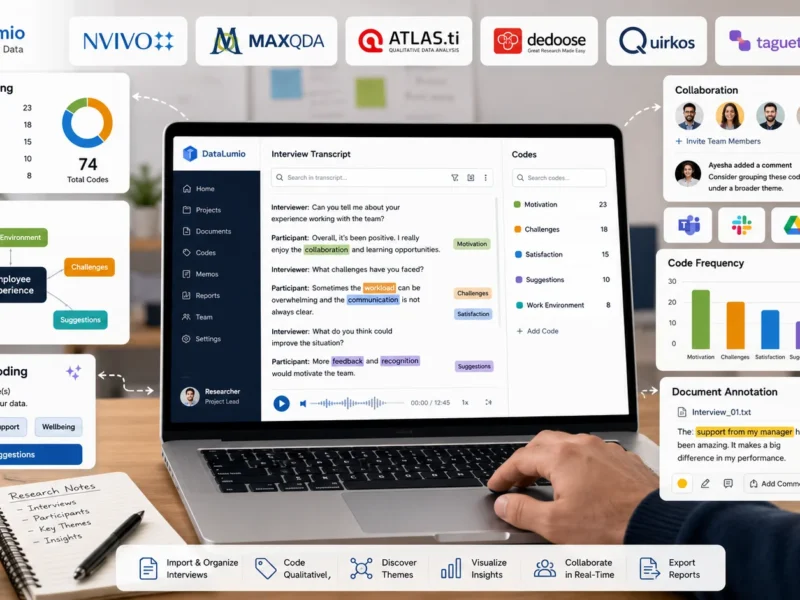
Primary keyword: AI qualitative data analysis | Search intent: Informational + Commercial | Target audience: Researchers, students, business professionals. Qualitative research helps us understand people’s experiences, opinions, motivations, and behaviours. However, analysing interviews, survey responses, research documents, and customer feedback manually can be time-consuming. Researchers often spend hours reading transcripts, highlighting important statements, assigning codes, and identifying recurring themes. AI qualitative data analysis offers a faster way to organise, explore, and interpret large amounts of text.
In this guide, you’ll learn how to analyse qualitative data using AI, explore common analysis methods, and discover how tools like DataLumio can support your research workflow without requiring programming knowledge.
What Is Qualitative Data Analysis?
Qualitative data analysis is the process of examining non-numerical information to understand meanings, experiences, behaviours, and patterns.
Unlike quantitative analysis, which focuses on numbers and statistical relationships, qualitative analysis explores what people say, think, and experience.
Common examples of qualitative data
- Interview transcripts from research participants.
- Open-ended survey responses.
- Focus group discussions.
- Customer reviews and feedback.
- Research documents and reports.
- Employee feedback and workplace interviews.
For example, imagine a researcher interviews 50 university students about their experiences with online learning.
Rather than calculating only satisfaction scores, qualitative analysis helps identify themes such as flexibility, motivation, technical difficulties, and communication with teachers.
Why Traditional Qualitative Analysis Takes So Much Time
Manual qualitative analysis usually involves several stages.
First, researchers read the collected information repeatedly to understand the context.
Next, they highlight meaningful statements and assign labels, known as codes.
These codes are grouped into broader themes, which are then interpreted to answer the research questions.
This process can become challenging when working with hundreds of pages of interviews or thousands of written survey responses.
Common difficulties include inconsistent coding, lengthy document review, managing overlapping themes, and maintaining traceability between findings and original evidence.
AI can assist with many of these tasks, although researchers must still validate the results.
How to Analyze Qualitative Data Using AI
Step 1: Collect and Organise Your Qualitative Data
Start by gathering the documents you want to analyse.
These might include PDF reports, Word documents, interview transcripts, or exported survey responses.
Organise your files using clear names, such as:
Student_Interview_01.docx
Customer_Feedback_January.pdf
Research_Interview_Transcript.docx
Before uploading, remove unnecessary personal information and ensure you have permission to process the data.
Step 2: Prepare the Data for Analysis
Good data preparation is essential for reliable qualitative research.
Check that your documents contain readable text, complete responses, consistent participant identifiers, and accurate transcripts.
If an interview was recorded, review the transcription before analysis. Incorrect transcripts can lead to misleading themes and interpretations.
For confidential research, anonymise participant names and identifying details where appropriate.
Step 3: Identify Your Research Questions
Before asking AI to analyse your documents, establish what you want to understand.
For example:
- What challenges do students experience during online learning?
- How do customers describe their experiences with a product?
- What factors influence employee satisfaction?
- Which problems appear repeatedly in customer complaints?
A clearly defined research question helps keep the analysis focused.
Step 4: Use AI to Explore Initial Codes
AI can help identify meaningful concepts within written responses.
Consider these fictional interview excerpts:
| Participant | Response | Possible code |
|---|---|---|
| Student A | “I struggle to stay focused during online classes.” | Concentration difficulties |
| Student B | “Internet problems interrupt my lectures.” | Technical barriers |
| Student C | “Recorded lectures allow me to study anytime.” | Learning flexibility |
| Student D | “I miss interacting with classmates.” | Social isolation |
The codes represent ideas expressed in the data.
AI-generated codes should be treated as suggestions rather than final research findings.
Step 5: Group Codes Into Themes
Once initial codes have been identified, group related concepts into broader themes.
For example:
| Theme | Related codes |
|---|---|
| Learning challenges | Concentration difficulties, distractions |
| Technical barriers | Internet connectivity, device limitations |
| Flexible learning | Recorded lectures, flexible schedules |
| Social experience | Isolation, limited peer interaction |
This process is often part of thematic analysis.
AI can suggest potential groupings, but the researcher should assess whether each theme accurately represents the original responses.
Step 6: Interpret and Validate the Findings
Finding recurring words is not the same as understanding their meaning.
Suppose 30 participants mention “flexibility”. Some may describe it positively, while others may say flexible schedules create difficulties with time management.
A useful analysis must consider these differences.
Review original quotations, look for contradictory responses, and assess whether the themes answer your research questions.
Step 7: Create a Qualitative Analysis Report
Your final report should explain the methodology, data sources, coding approach, identified themes, supporting evidence, and limitations.
A clear report might contain:
- Research objective and methodology.
- Description of the dataset.
- Coding and thematic analysis approach.
- Key themes and supporting quotations.
- Interpretation and discussion.
- Limitations and recommendations.
AI can help structure and summarise the report, but every important conclusion should be supported by the underlying data.
How DataLumio Supports AI Qualitative Data Analysis
DataLumio is a no-code AI data analytics platform designed to help users work with both qualitative and quantitative information.
Its qualitative analysis capabilities support workflows involving PDF and Word documents.
For researchers and business professionals, DataLumio can help reduce the manual effort involved in reviewing lengthy text documents and extracting meaningful insights.
A practical workflow is to upload supported documents, run the qualitative analysis, examine the resulting insights, and verify the findings against the original material.
DataLumio also offers quantitative analysis capabilities for Excel and CSV datasets, making it relevant for projects that involve both numerical and textual information.
AI Qualitative Data Analysis vs Manual Analysis
| Feature | Manual analysis | AI-assisted analysis |
|---|---|---|
| Reading documents | Researcher-led | AI-assisted summarisation |
| Initial coding | Manual coding | Suggested codes |
| Theme discovery | Researcher identifies themes | AI suggests themes |
| Consistency | Depends on coding process | Requires AI output validation |
| Contextual interpretation | Strong human judgement | Requires human oversight |
| Large text collections | Labour-intensive | Can accelerate exploration |
AI is particularly useful for organising and exploring large volumes of text, while human researchers remain essential for interpretation and methodological rigour.
Practical Use Cases of AI Qualitative Analysis
Academic Research
University students and researchers can use AI to explore interview transcripts, identify emerging themes, and organise research findings.
Customer Feedback Analysis
Businesses can analyse written reviews, support messages, and survey responses to identify common concerns and improvement opportunities.
Employee Experience Research
HR teams can examine employee feedback to understand workplace communication, leadership concerns, and job satisfaction.
Market Research
Market researchers can analyse focus group transcripts and customer interviews to understand preferences, expectations, and purchasing motivations.
Education Research
Teachers and educational researchers can investigate student feedback, classroom experiences, and learning challenges.
Common Mistakes to Avoid When Using AI for Qualitative Research
Accepting AI-generated themes without verification: AI may group unrelated statements or overlook important context.
Ignoring contradictory evidence: A reliable analysis should examine responses that challenge the dominant themes.
Confusing frequency with importance: A theme mentioned by only a few participants may still be highly significant.
Overlooking privacy: Sensitive interviews and confidential documents require appropriate handling and consent.
Failing to document the methodology: Researchers should explain how AI was used, how themes were developed, and how findings were validated.
Best Practices for Reliable AI Qualitative Analysis
For stronger results, combine AI-assisted exploration with established qualitative research principles.
Maintain an audit trail of coding decisions, review representative quotations, document changes to your themes, and remain transparent about AI assistance.
For formal academic work, follow the relevant institutional requirements regarding AI use and research ethics.
Frequently Asked Questions
Can AI analyse qualitative data?
Yes. AI can help organise text, suggest codes, identify recurring themes, and summarise qualitative information. Human validation remains important.
What is the best method for analysing qualitative data?
The appropriate method depends on the research question. Common approaches include thematic analysis, content analysis, grounded theory, and narrative analysis.
Can I analyse interview transcripts using AI?
Yes. AI can assist with exploring interview transcripts, suggesting codes, and identifying patterns across participant responses.
Can AI perform thematic analysis automatically?
AI can support coding and theme generation, but a rigorous thematic analysis still requires researcher interpretation, contextual understanding, and validation.
Can DataLumio analyse qualitative research documents?
DataLumio supports qualitative analysis workflows involving PDF and Word documents, helping users explore textual information through AI-assisted analysis.
Conclusion
Learning how to analyse qualitative data using AI can help researchers and organisations work more efficiently with interviews, surveys, feedback, and research documents.
AI can accelerate document review, coding suggestions, theme discovery, and report preparation. However, meaningful qualitative research still depends on human judgement, methodological transparency, and careful validation.
For users seeking a no-code approach, DataLumio provides a way to explore qualitative documents alongside broader AI-powered data analytics workflows.
Explore DataLumio’s AI data analysis platform to get started.