When a team finishes 24 customer interviews, the difficult part often starts after the conversations end. Someone has to read the transcripts, identify meaningful statements, label recurring issues, and work out which findings deserve attention.
Qualitative coding gives this process structure. Instead of relying on memory or selecting a few memorable customer comments, your team can apply consistent labels to interview statements and trace each finding back to its original source.
This guide explains how to code qualitative data using a practical customer churn example. You will learn how to create a code frame, tag interview transcripts, combine overlapping codes, check consistency between two people, and turn coded responses into a finding your stakeholders can act on.
Quick Answer: How to Code Qualitative Data
Follow this five-step coding loop:
- Build a code frame: Define the customer issues your team needs to investigate and write clear rules for each code.
- First-pass coding: Read transcripts and tag meaningful statements using the code frame.
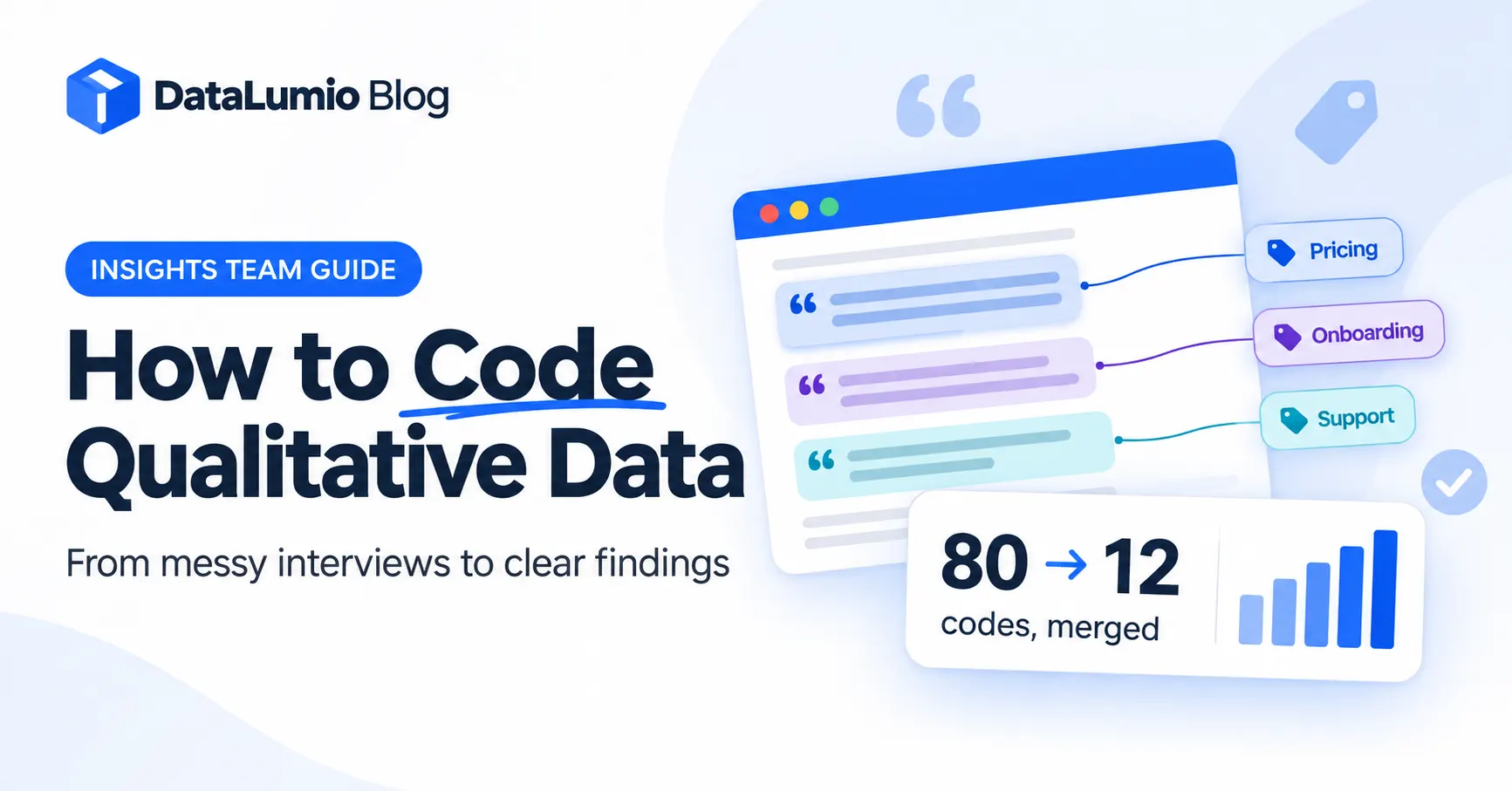
- Merge overlapping codes: Combine duplicate or closely related labels while preserving meaningful differences.
- Check coding consistency: Have two people code the same transcripts, compare their decisions, and resolve unclear definitions.
- Turn codes into findings: Review how frequently issues appear, select supporting quotations, and explain what the evidence means for the business.
The process is iterative. Your team may need to revise a code definition after seeing how customers describe an issue in actual conversations.
What Coding Qualitative Data Means
Qualitative coding is the process of assigning short labels to meaningful sections of written or spoken information. These labels, called codes, describe what a particular statement communicates in relation to your research question.
For example, imagine a customer explaining why they stopped using a subscription product:
“I liked the product, but every time I needed help, I had to wait two or three days for someone to respond.”
A suitable code might be Slow Support Response. The label captures the customer’s complaint without changing the meaning of their statement.
A transcript can contain several different codes. One customer might discuss pricing, product reliability, onboarding, and support in the same interview. Coding allows your team to separate these issues and examine how they appear across multiple conversations.
Deductive vs. Inductive Coding
There are two common starting points for qualitative coding.
Deductive coding begins with predefined categories. Your team develops codes from an existing research question, business problem, customer journey, or set of stakeholder priorities.
For example, if the business wants to understand customer churn, you might begin with pricing, product usability, technical problems, customer support, and onboarding.
Inductive coding begins with the data itself. You read the transcripts and create codes based on ideas that repeatedly appear in customer responses, including issues your team did not anticipate.
Suppose several customers mention that they cannot find previously saved reports. If report retrieval was not part of your original code frame, you can introduce a new code for it.
For a business team working against a specific deadline, a combined approach is often practical. Start with deductive codes based on the stakeholder question, then add inductive codes when the transcripts reveal something your initial framework missed.
Rule: Start deductively when you already know what business question needs answering, and add inductive codes whenever the evidence introduces a genuinely new issue.
Step 1: Build a Code Frame From Your Research Question
A code frame is an organized set of labels and coding rules. It tells everyone working on the project what each code means, when to apply it, and when a statement belongs somewhere else.
Without these definitions, two people might label the same customer complaint differently. One person might use “Support Problems,” while another uses “Slow Response,” even though both are describing the same underlying issue.
Consider this illustrative example.
A subscription business has completed 24 customer interviews. Management wants to understand why customers cancel their subscriptions.
The team identifies five initial areas of investigation:
- Pricing and perceived value
- Product usability
- Technical reliability
- Customer support
- Onboarding and adoption
The following code frame shows how these areas can become practical coding rules.
Illustrative Customer Churn Code Frame
| Code name | Definition | Include when | Exclude when | Example quote |
|---|---|---|---|---|
| High Subscription Cost | Customer considers the subscription too expensive | They describe price as unaffordable | They complain about missing value without mentioning cost | “The monthly payment became difficult to justify.” |
| Poor Value for Money | Customer believes the product does not justify its price | They compare cost with perceived benefits | They mention only a temporary payment issue | “I wasn’t getting enough out of what I paid.” |
| Confusing Navigation | Customer struggles to find product functions | They describe difficulty locating features | A feature is unavailable or broken | “I couldn’t find the settings I needed.” |
| Difficult Onboarding | Customer struggles during initial setup or learning | They describe problems getting started | They discuss later product navigation problems | “It took me weeks to understand the setup.” |
| Missing Functionality | Customer cannot find a required product capability | They identify a missing feature or workflow | An existing feature is difficult to operate | “There was no way to export the report I needed.” |
| Product Reliability | Customer experiences crashes or unexpected failures | They describe unstable product behavior | They report a specific performance delay without failure | “The application kept closing unexpectedly.” |
| Slow Performance | Customer reports delays or poor response speed | They mention slow loading or processing | The application crashes or becomes unavailable | “Opening a report took far too long.” |
| Slow Support Response | Customer experiences delayed assistance | They describe waiting for support | Support responds quickly but fails to solve the issue | “I waited three days for an answer.” |
| Unresolved Support Issue | Customer receives assistance without a satisfactory resolution | Their problem remains unresolved after support contact | They only complain about response time | “They replied, but my issue was never fixed.” |
| Low Product Adoption | Customer does not use the product regularly | They describe limited usage or abandonment | They identify a specific technical barrier without discussing usage | “We stopped using it after the first month.” |
These ten codes are starting categories, not permanent labels. The team should test them against the actual interviews and revise definitions when the evidence exposes ambiguity.
A useful code frame should remain small enough to apply consistently. Adding a new label for every variation in customer wording makes the coding process harder to manage.
Step 2: First-Pass Coding
First-pass coding means reading each transcript and assigning relevant codes to meaningful sections of text.
Work through one transcript at a time. Highlight a sentence or passage that communicates something relevant to the churn question, then apply the code that best describes its meaning.
Consider this illustrative interview excerpt:
“The software worked well at first. But I couldn’t find the reporting tools, and whenever I contacted support, I had to wait several days. Eventually, I stopped using the subscription.”
This passage contains several separate ideas.
| Customer statement | Code |
|---|---|
| “The software worked well at first.” | No code needed for the churn question |
| “I couldn’t find the reporting tools.” | Confusing Navigation |
| “I had to wait several days.” | Slow Support Response |
| “I stopped using the subscription.” | Low Product Adoption |
One passage can receive multiple codes when it contains distinct, relevant ideas. Do not force the entire paragraph under a single label.
What Should You Tag?
Tag statements that help answer your research question.
For a churn investigation, these might include:
- Reasons customers considered cancelling.
- Specific product problems.
- Frustrations with support.
- Price objections.
- Features customers expected but could not find.
- Experiences that influenced their decision to leave.
What Should You Skip?
Avoid coding every sentence simply because it appears in a transcript.
Skip greetings, unrelated small talk, administrative information, and statements that provide no useful evidence for the business question.
However, do not discard a statement simply because it appears only once. An unusual complaint can reveal a serious problem that a frequency count would overlook.
How Long Does One 45-Minute Transcript Take?
There is no dependable universal time. Transcript quality, reading speed, the number of relevant statements, code frame clarity, and the amount of context required all affect the duration.
For an honest internal benchmark, select one representative 45-minute transcript and record:
- Time spent reading and understanding the interview.
- Time spent assigning initial codes.
- Time spent checking ambiguous passages.
- Time spent reviewing the completed coding.
Report the observed time rather than using an assumed industry average. Once you have measured several transcripts, you can estimate the remaining workload for your team.
Step 3: Merge and Collapse Codes
Your first coding pass may produce more labels than you need.
This happens because customers describe similar experiences using different language. One customer might say support was slow, another might mention delayed replies, and a third might complain about waiting too long for assistance.
These statements may represent the same underlying issue.
The objective is to reduce unnecessary duplication without removing meaningful distinctions.
Before: An Illustrative Messy Code List
Imagine the team initially produces these 17 labels:
- Expensive Subscription
- High Monthly Fee
- Too Much Money
- Poor Price-to-Value Ratio
- Confusing Dashboard
- Difficult Navigation
- Hard to Find Features
- Missing Features
- Feature Requests
- Application Crashes
- Unexpected Errors
- Slow Loading
- Delayed Support Replies
- Slow Customer Service
- Unresolved Complaints
- Difficult Initial Setup
- Low Product Usage
After: A More Consistent 12-Code Frame
| Final code | Original labels merged or retained | Decision |
|---|---|---|
| High Subscription Cost | 1, 2, 3 | Combine different descriptions of expensive pricing |
| Poor Value for Money | 4 | Retain because perceived value differs from price alone |
| Confusing Navigation | 5, 6, 7 | Combine difficulty finding and navigating existing functions |
| Missing Functionality | 8, 9 | Combine unavailable capabilities and feature requests |
| Product Reliability | 10, 11 | Combine crashes and unexpected errors |
| Slow Performance | 12 | Retain because loading speed differs from reliability |
| Slow Support Response | 13, 14 | Combine delayed replies and slow customer service |
| Unresolved Support Issue | 15 | Retain because an unsuccessful resolution differs from delayed assistance |
| Difficult Onboarding | 16 | Rename to describe the initial adoption experience |
| Low Product Adoption | 17 | Retain as a separate usage-related issue |
| Positive Product Experience | New | Add if positive experiences are relevant to the churn question |
| Competitor Switching | New | Add if customers describe moving to another provider |
The two new codes should only be added if the interviews contain relevant evidence. They are not assumed to exist in the dataset.
How to Decide Whether Two Codes Should Merge
Ask whether the two labels describe the same underlying issue.
If customers are using different words to describe the same experience, combining the codes usually makes sense.
If the distinction changes what the business should investigate or do, retain separate codes.
For example, slow support response and unresolved support issues may sound similar, but they suggest different operational problems. One concerns response time, while the other concerns whether the customer’s problem was solved.
After merging, update the code frame and apply the revised definitions consistently to previously coded transcripts.
Step 4: Check Agreement When Two People Code
When two team members code the same interview independently, their decisions may differ.
One person might classify a complaint as Poor Value for Money, while another selects High Subscription Cost. Neither decision should be accepted automatically.
A practical agreement check involves four actions.
First, select two transcripts. Both team members should independently code the same two interviews using the current code frame.
Second, compare their decisions. Look at the passages each person selected and the labels they assigned. Identify passages where they chose different codes or interpreted the same statement differently.
Third, discuss disagreements. Determine whether the issue comes from unclear definitions, overlapping codes, missing categories, or different interpretations of the customer statement.
Fourth, revise the code frame. Update definitions, include and exclude rules, and example quotations. Then have both people review the revised rules before continuing.
For teams that need a formal numerical measure, Cohen’s kappa is one method of assessing agreement beyond chance, but its suitability depends on the coding design and assumptions.
The purpose of this exercise is to make coding decisions more consistent, not to force two people to agree on every interpretation.
Keep a simple record of disagreements and changes. This creates an audit trail that explains how your coding framework developed.
Step 5: Turn Codes Into a Finding
Once the transcripts have been coded and reviewed, your team can examine which issues appear across customer interviews.
Code counts can help identify recurring problems, but frequency alone does not establish business importance. A serious problem mentioned by only two customers may deserve attention even if another issue appears in ten interviews.
Consider this illustrative summary from the 24-interview churn example.
| Code | Interviews containing the code |
|---|---|
| High Subscription Cost | 11 |
| Confusing Navigation | 9 |
| Slow Support Response | 8 |
| Missing Functionality | 7 |
| Product Reliability | 5 |
| Poor Value for Money | 5 |
These are fictional counts for demonstrating the process, not findings from an actual customer dataset.
Suppose the team also reviews the supporting quotations and discovers that customers mentioning confusing navigation often describe difficulty locating reporting functions.
A weak report might say:
“Confusing navigation was mentioned in nine interviews.”
That statement describes the count but does not tell management what to do.
A more useful finding would be:
“Difficulty locating reporting functions appeared in nine of the 24 interviews, suggesting that the reporting interface and feature discoverability deserve a closer product review.”
This connects the coded evidence to a practical business decision.
Before sharing the finding, check the original quotations, identify contradictory responses, and confirm that the statement does not claim more than the interviews support.
If your next task is to organize recurring codes into broader patterns of meaning, continue with our guide to AI thematic analysis.
Where AI Speeds Up Coding and Where to Check It
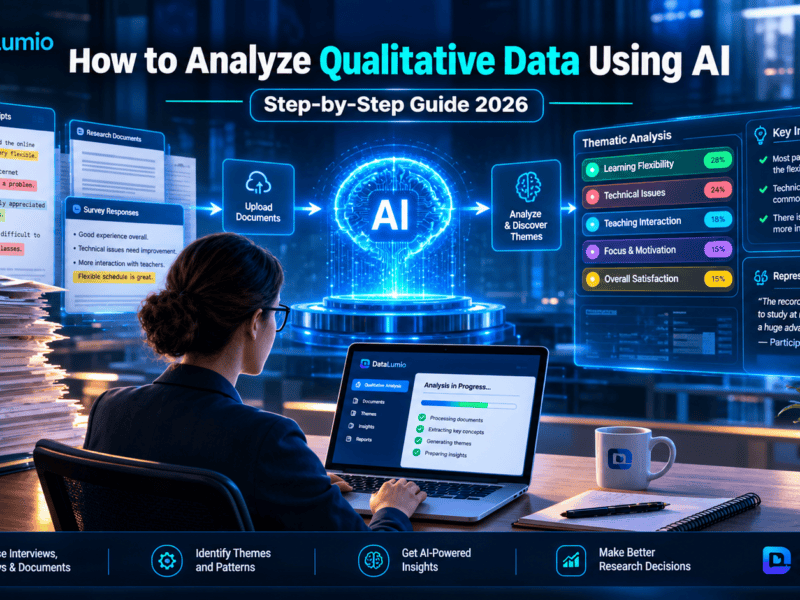
AI can help teams examine lengthy transcripts and suggest possible labels for meaningful passages. It can also identify repeated expressions and help organize large amounts of written feedback.
For example, an AI-assisted workflow might identify several customer statements involving delayed assistance and suggest the label Slow Support Response.
This can give your team a useful first pass, particularly when reviewing 20 to 40 interviews or hundreds of open-ended survey responses.
However, an AI-generated label is a suggestion, not a verified coding decision.
A statement about slow support could actually describe an unresolved complaint, a delayed technical fix, or a communication problem. The surrounding conversation determines which interpretation fits.
Use the following review process:
- Ask AI to suggest possible codes for relevant passages.
- Compare the suggestions with your existing code frame.
- Check the complete source passage and surrounding context.
- Correct labels that do not match the customer’s meaning.
- Record any new code definitions before adding them to the final dataset.
A person should check every code against its original source quotation before it enters a stakeholder report.
For a deeper explanation of this workflow, read how to analyze qualitative data using AI.
How to Code Qualitative Data in DataLumio
DataLumio supports AI-assisted analysis of text-based research documents, including PDF and DOC files. Its workflow is designed to help users move from uploaded material to structured findings without having to build a traditional manual coding system from scratch.
Start by uploading your supported interview transcripts or documents. Select qualitative analysis and provide a research question that explains what your team wants to investigate.
You can guide the analysis with specific prompts and themes, or leave those fields empty for an exploratory first pass. DataLumio can identify candidate themes, surface supporting quotations, examine sentiment, and compare patterns across uploaded documents.
Review the generated findings against the original customer statements before sharing them. Treat automatically identified categories as analytical suggestions rather than a finalized codebook.
The platform also organizes findings into structured reports that can be downloaded for further review. This can help an insights team prepare evidence for a stakeholder discussion without manually reconstructing every initial observation.
If your team requires detailed manual code hierarchies, independent coder agreement calculations, or a formal coding audit trail, verify those requirements separately before selecting a platform.
Explore DataLumio’s qualitative data analysis workflow to see how it handles interview transcripts and other text-based material.
Frequently Asked Questions
What Is the Best Software for Qualitative Coding?
The best software depends on whether your team needs traditional manual coding or AI-assisted analysis. For a simpler starting point, see our guide to the easiest qualitative data analysis software to learn. Compare the available workflows with your coding, evidence-review, and collaboration requirements before choosing.
What Tools Help Me Tag and Code Qualitative Research Faster?
Document coding software can help organize passages and apply labels, while AI-assisted platforms can suggest categories and surface relevant quotations. The right choice depends on your workflow. Our guide to the easiest QDA software to learn explains the differences between these approaches.
Can Non-Researchers in Marketing Code Qualitative Data?
Yes. Marketing teams can code customer interviews, feedback forms, reviews, and open-ended survey responses without advanced methodological training. Start with a clear business question, define a manageable code frame, and check that each label represents what customers actually said. For more complicated projects, involve someone with qualitative analysis experience.
Can AI Code Qualitative Data Automatically?
AI can suggest labels, identify recurring concepts, and organize related passages, reducing some manual work. However, automated coding can misunderstand context, sarcasm, or differences between similar complaints. A team member should verify every code against the original statement and correct inaccurate classifications before using the results.
How Much Does Qualitative Analysis Software Cost for a Team of 10?
Costs depend on whether a provider charges per user, per project, through subscriptions, or through shared usage credits. Some platforms offer organization-level pricing instead of individual licenses. DataLumio currently lists monthly plans and an enterprise option, but a confirmed 10-person team quote should be obtained before calculating the total budget.
Can I Analyze Interviews and Share Findings With My Team the Same Day?
Yes, depending on transcript quality, interview volume, and the amount of validation required. AI-assisted analysis can help organize findings more quickly, but your team still needs to check supporting quotations and resolve unclear classifications. For a same-day handoff, keep the research question focused and prepare a short evidence-based report.
Your Next Step
Before coding your full interview collection, test the code frame against two representative transcripts. Revise overlapping definitions and agree on the rules your team will follow. Then code the remaining interviews, verify the evidence, and prepare a short findings report that connects customer feedback to a business decision. If you want to speed up the initial review, explore DataLumio’s qualitative analysis workflow.